
Poetry Salon - August
How to write a poem when the world is on fire

Hello Everyone
Before I share this month’s poetry salon with you, a little shop admin:
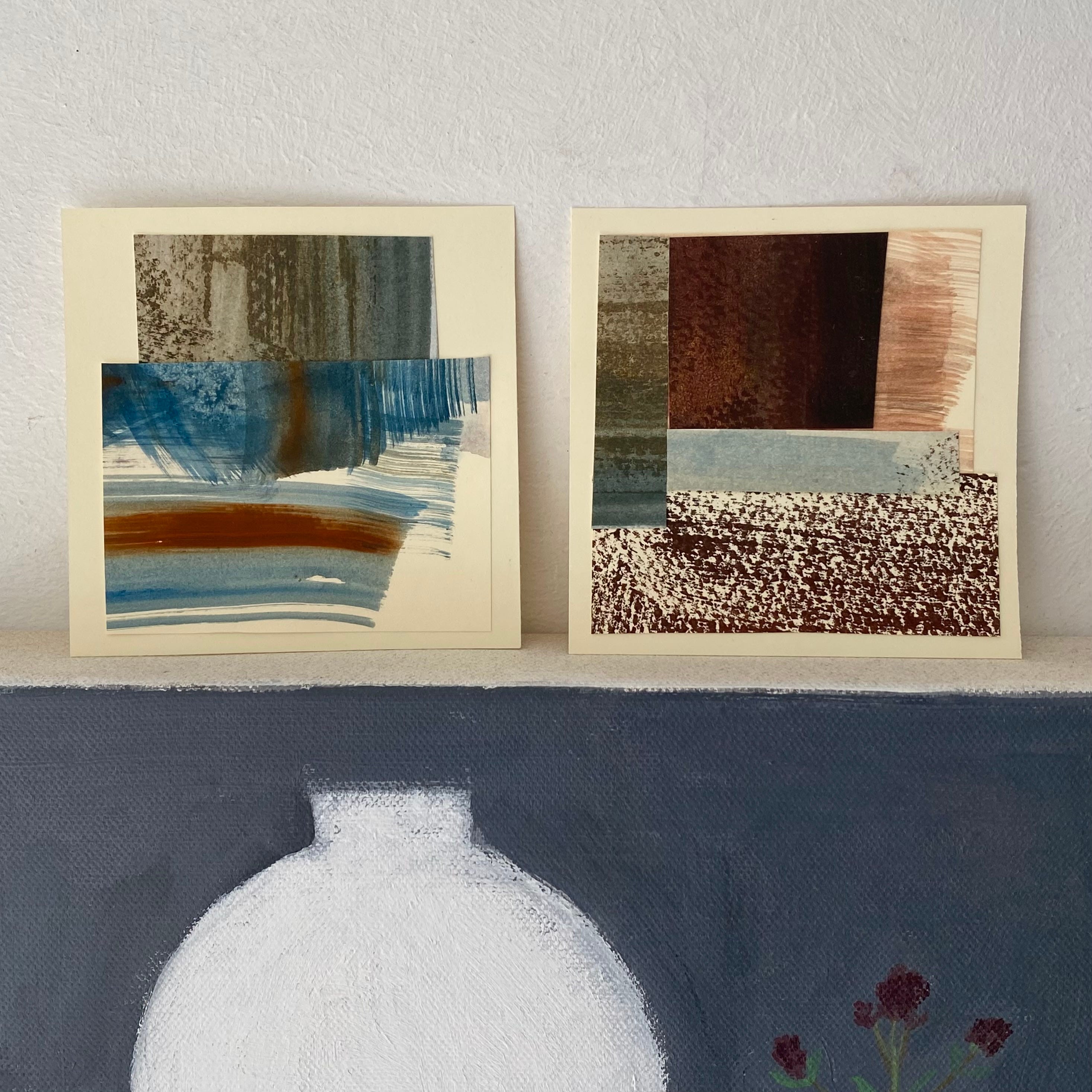
I am grateful to everyone who has purchased artwork from me recently. My ‘lucky dip’ drawing offer, which was available over the past two months, is now closed. I had a small flurry of orders this week so am going to get them sent out asap - and I will be launching my next ‘lucky dip’ just as soon as I have happily fulfilled outstanding requests. The future ‘lucky dip’ for the next few months will be something quite different - as you may see from above - I will be offering a small abstract collage, sent to you as a random pick from work I will be creating. More details soon.
my next shop update will be Wednesday 5th August at 7pm UK time with preview from about 4pm.
****
How to write a poem when the world is on fire
This is not a protest essay and you don’t need me to tell you just how changed our planet has become. The news is full of how the climate’s accelerated changes are causing a myriad of problems. There are wild fires, ice melting, endangered species, famine, flood…
And so how, on this tiny precious earth, can a poet simply write a poem, especially about nature in mind, without feeling completely overwhelmed?
Somewhere, right now, someone not too far from you is writing a protest poem. It may be full of rage and sadness - and what-about-isms. And I do not have criticism for writing protest poems. There are powerful poems of protest to be read. But I want to encourage you to write beyond the protest, or to write/read poems that consider nature in a quieter, yet no less powerful, way.
Three Things
Step outside. Whether it is raining, snowing or blistering hot (but be safe). Take a look around what is on your doorstep, or nearby road. Note three things from the natural world. They may not all be pretty. Hold these three things in your mind or scribble them down in your journal/diary/notepad.
What three things do you have?
Here are mine: Verbascum, Thistle, bluebottle fly
I’ll keep hold of these and might write about one or two or all three. Or none. I might simply get into a habit of noticing three things.
Days will go by and the three things might stay the same or change. I might want to see beyond the same, so I’ll start looking a little more carefully. I may decide to leave home at a different time of day, just to notice something.
And if I start to note these changes, I may come up with an idea of how things are over a period of days or weeks.
Here’s a draft of a poem about writing a ‘three things poem’. Now, you may know I am committing a poetry crime for writing a poem about writing a poem - but perhaps forgive me on this occasion.
Three Things
Three things written
do not make a poem
but my handwriting is hurried
finger-itchy
to share something I have
yet to know
(no, don’t swallow a fly
or tread on a thistle -).
I could just lose myself.
Better water words wisely,
conserve, not bottle-up.
(Cathy Cullis 2026)
Read Poets Who Write Brilliantly About Nature
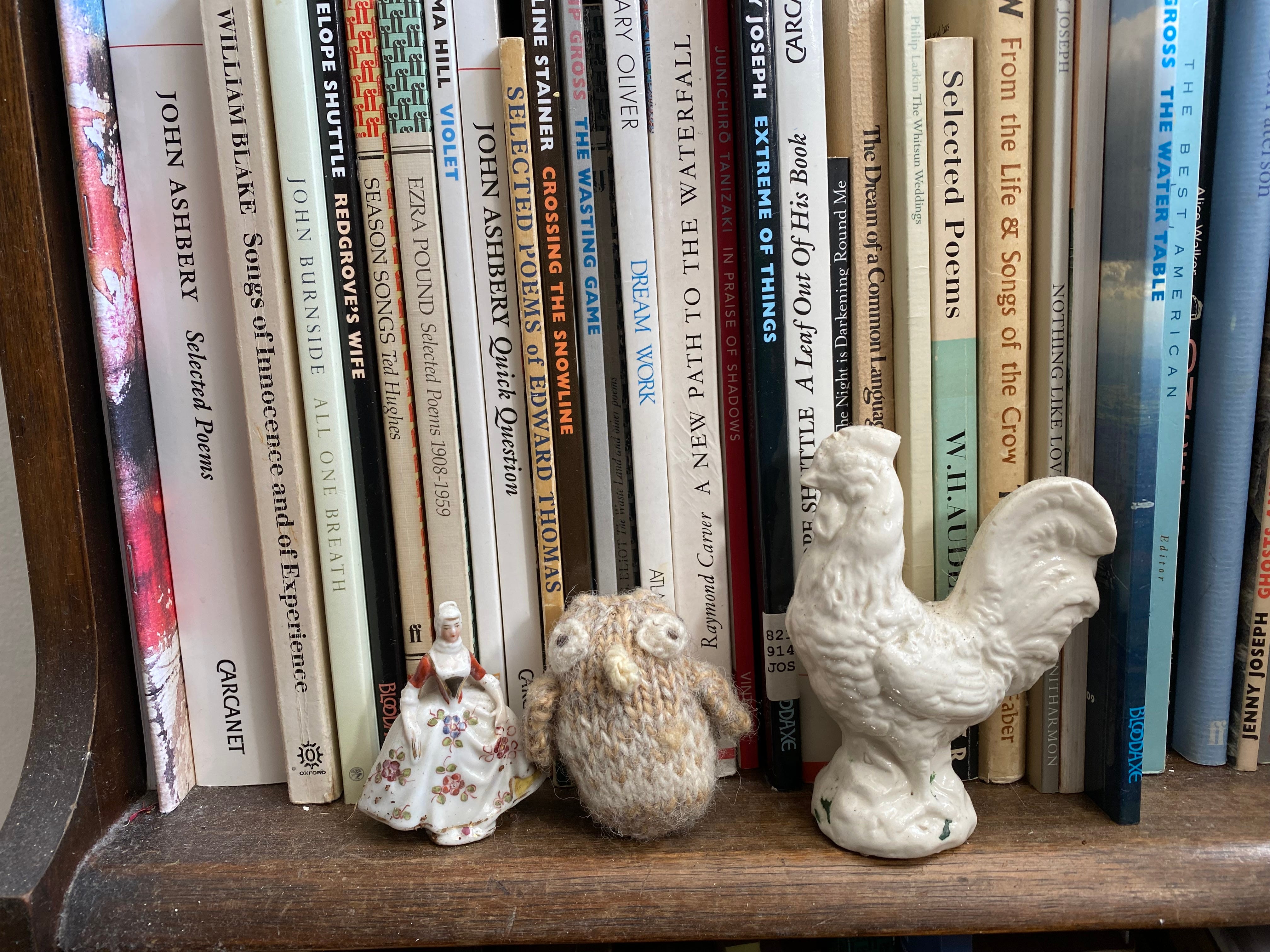
Here’s one of my poetry bookshelves. I don’t have a vast poetry collection. But those I do have are all intentionally there, waiting for me to return to them, as I often do. Many of my favourite poets write about nature in inventive ways. Their distinctive voices are there for me, on the page, to remind me of how looking deeply, listening to the natural world, really has mattered to people for many, many years.
Nature, not as a romantic folly, a tossed salad of pretty images - nature as often dark, alien or remote, struggling perhaps, grim maybe, ferocious, eternal, elemental forces. Something humanity can connect with and feel a part of, and yet feel apart. Many poets look to nature to understand our own mortality.
Some of my favourite poets who write deeply about nature include: Ted Hughes, John Burnside and Alice Oswald.
Please do suggest any poets who write about nature, in particularly distinctive ways, in the comments.
Here below is part of a poem by Alice Oswald, from her 2015 collection ‘Falling Awake’ (pub: Cape Poetry)
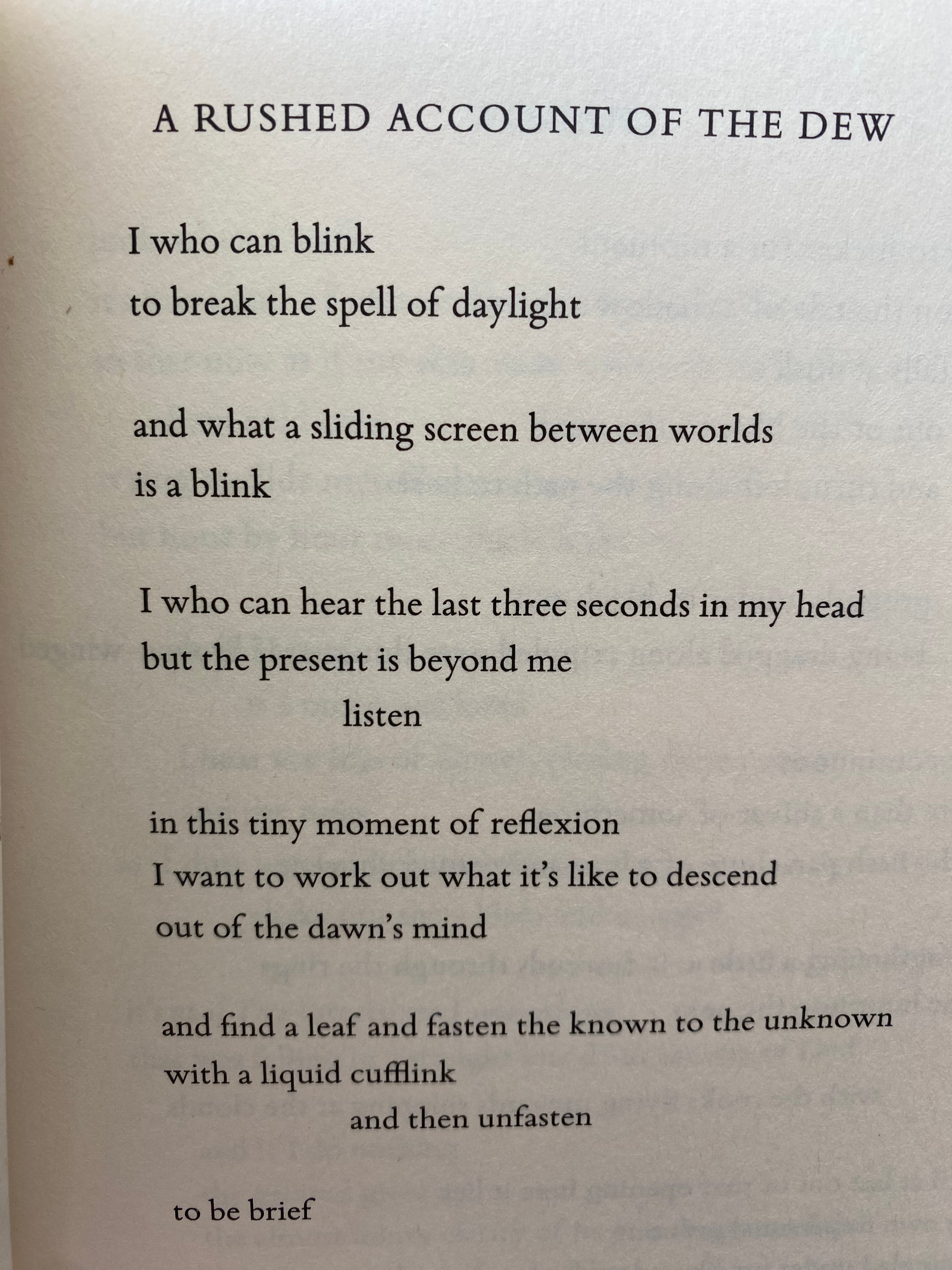
This poem share with the reader a very particular response to morning dew - how it is possible to connect with the natural world and yet nature remains forever elusive…
It’s that honing in, a particular-ness, that matters and can make linger in the reader’s mind.
**
Minimalism & Form
I will write more on minimalism and small poems in a future poetry salon post.
Writing less can be a far superior use of time. A blank page is unsatisfactory, but so is wading through turgid and self-indulgent writing. It takes effort to write less and make sense, or suggest a sense. But minimalism does not stem from mere cutting back or editing to the bare bones of an imagined garden. Many of us were made to write ‘nature haiku’ in school - to learn the form of haiku and tick a certain box about that. I am not dismissive of haiku, but I have little time for using a form of poetry simply because - so consider, how best to write and which form to use, and how your subject might inform this
**
Nostalgia & Poems About Nature
Just as there is a place for protest, there is a room also for nostalgia.
I often get carried away when I write first drafts of poems and find myself back in a childhood that might not have existed, a place filled with mild and easy-going weather, days spent outdoors. Or I might focus in on a particular dark memory - for example, I have tried and tried again to write a poem about digging up a dead hamster! (I was burying another dead hamster - the things we did in school back then!).
We misremember. But does nature remember us at all? The ways in which we move through the world varies throughout our lifetimes. To some people nature is always Nature, to others it is: that thing to deal with, or live beside.
Many children of my generation (growing up in 70’s and 80’s) lived literally close to earth, playing outdoors, getting increasingly grubby and hands-on with dirt, creatures and elements. It is worth remembering this but writing about this experience has often proved tricky for me. I don’t want to romanticise a time in my life that was often unhappy, a struggle. But at the same time, I do want to acknowledge how much I value the experience I had - which is different to the experience my own children had, for a variety of reasons.
**
Just Write and Acknowledge
I would like to encourage you to write a poem about nature today. Don’t leave it until tomorrow, or when you might have ‘a spare few hours’. Just show up and write, acknowledge the things you see in this world of ours, be as playful, as cryptic, as minimal, as maximal, as song-driven, as contradictory - as you please. But please write a poem about nature today. And put this poem somewhere safe, perhaps fire-proof, flood-proof. We need the people who come after us to know we spent time looking and thinking.
**
Thank you for reading! I would very much appreciate your thoughts and comments.
Have a good weekend.
I haven’t written poetry in decades…thank you for this invitation.
I stepped softly into the blistering heat of the day and looked around.
These are my three things:
A marigold growing through cracked pavement.
Wild grasses feeding more than bees.
A tiny rabbit trusting the shade of a tree.
I look forward to sitting with these a while longer…
I immediately thought of Wendell Berry (https://www.poetryfoundation.org/poets/wendell-berry), and then I spent two days trying to get logged in on Substack so I could post a comment.
Also I wanted to tell you, Cathy, that I received the art piece and it was perfect and beautiful. Thanks again.